The mouse in the closet metaphor in the cyber world: why it’s important to keep track of all your applications
Cyber Security
data-driven, Inventory
In many organizations, application risk gets associated mainly with the most visible systems, the ones that support essential processes and therefore stay under the constant attention of IT and cyber teams.
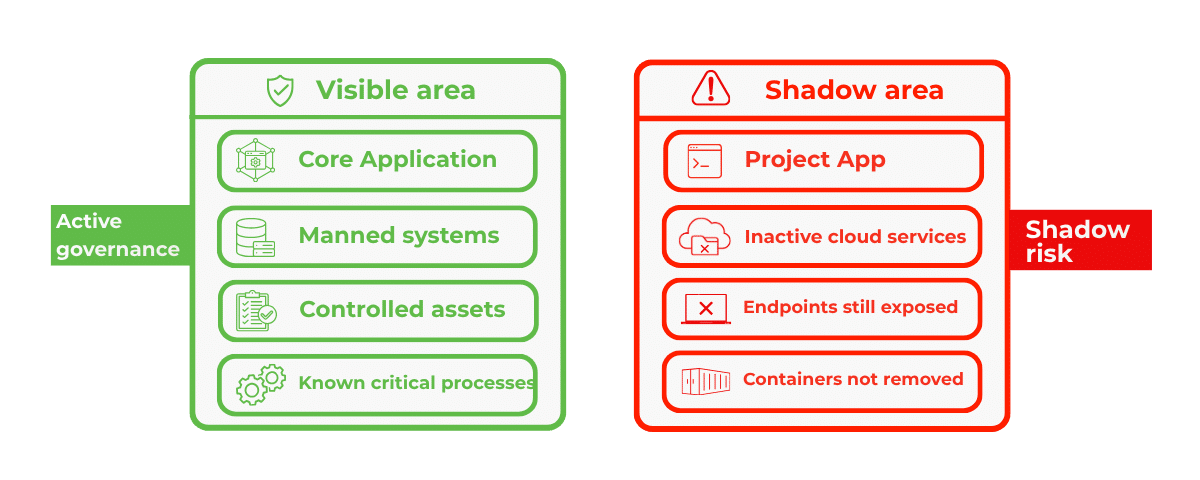
There is, however, a part of the application environment that lives in a kind of blind spot, made up of tools introduced during projects that have long since closed, cloud services left running out of sheer inertia, and components born inside containerized environments that keep existing even after their original purpose has been served.
This hidden portion of the infrastructure is one of the most delicate areas of Cyber Risk Management, because it tends to slip past traditional inventories and periodic control activities, and because its real scope is often far wider than risk owners tend to assume. Understanding where these applications sit and why they continue to exist is the first step toward assessing the weight they carry on the organization's overall exposure, and toward bringing them back under control.
Where the risk of forgotten applications comes from
It’s rare for these forgotten applications to formally exit corporate governance once their use has ended. More often they slip slowly out of sight, because nobody takes responsibility for formalizing their decommissioning and the team that originally introduced them has since moved its attention elsewhere. In other cases they stay active out of caution, on the assumption that they might still be useful, even though no one has actually relied on them for a long time.
To explain this kind of risk, the metaphor of the mouse in the closet helps. As long as it stays hidden, the problem seems not to exist, because the closet door is shut and the room looks tidy. In reality, the mouse keeps moving and gnawing away even when nobody sees it, and the damage it causes grows precisely during the time it goes unnoticed. By the time its presence is discovered, it is inevitably already late, and getting back to normal takes far more time and effort than it would have taken to step in early.
Applications created by containers and temporary environments
In recent years this phenomenon has extended to containerized environments too, where the ability to spin up new components quickly has made technical teams far more agile, while making it just as hard to maintain an up-to-date view of what is actually still running.
A container, for instance, might be created to test a new feature or support a narrowly scoped project phase. When it isn’t removed once that purpose has been served, or when it stays connected to a network with broader permissions than necessary, it turns into a hidden element inside the infrastructure. The speed at which these components get generated often outpaces the organization’s ability to keep track of them, to the point where a cluster can host workloads that have been running for some time without the cyber team having full visibility into them.
From declared visibility to data driven
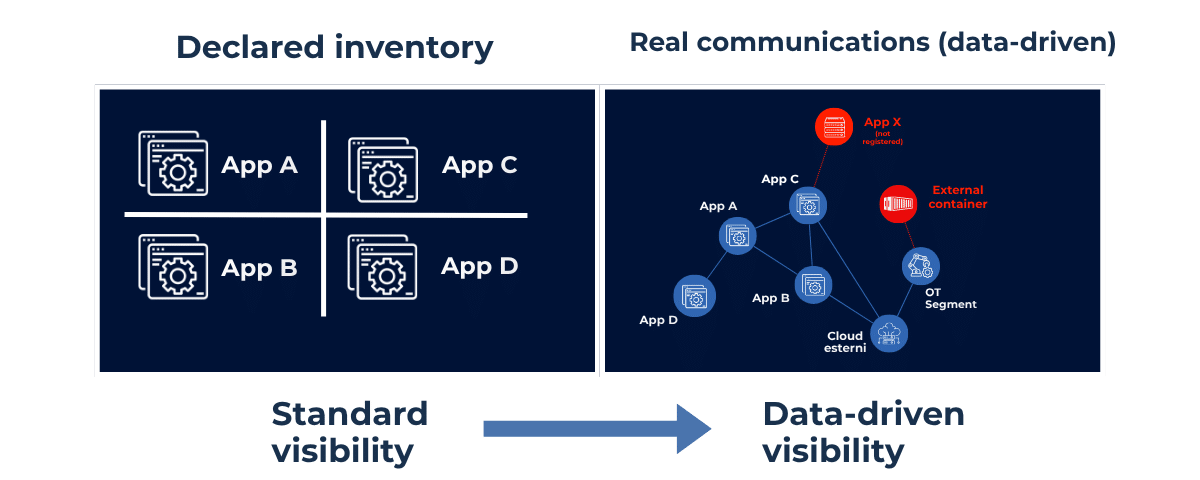
Today, for a CISO or a Risk Manager, what matters is understanding which applications are still communicating, and whether that traffic reflects a genuine organizational need or is simply a leftover from configurations nobody ever removed. Working with this information means having access to insights that often don’t show up in internal documentation, yet become decisive when it’s time to decide where to act first.
On this basis, it becomes necessary to build a priority order that reflects the organization’s actual exposure, giving precedence to applications that occupy sensitive positions within the network even when they’re considered marginal, while applying proportionate attention to well-known systems that remain under control thanks to consistent maintenance processes. For those who then need to bring these topics to a risk committee or to the board, working this way also makes it possible to justify investment and intervention decisions on the basis of concrete evidence about how the infrastructure actually behaves.
The role of ESRA in discovering forgotten applications
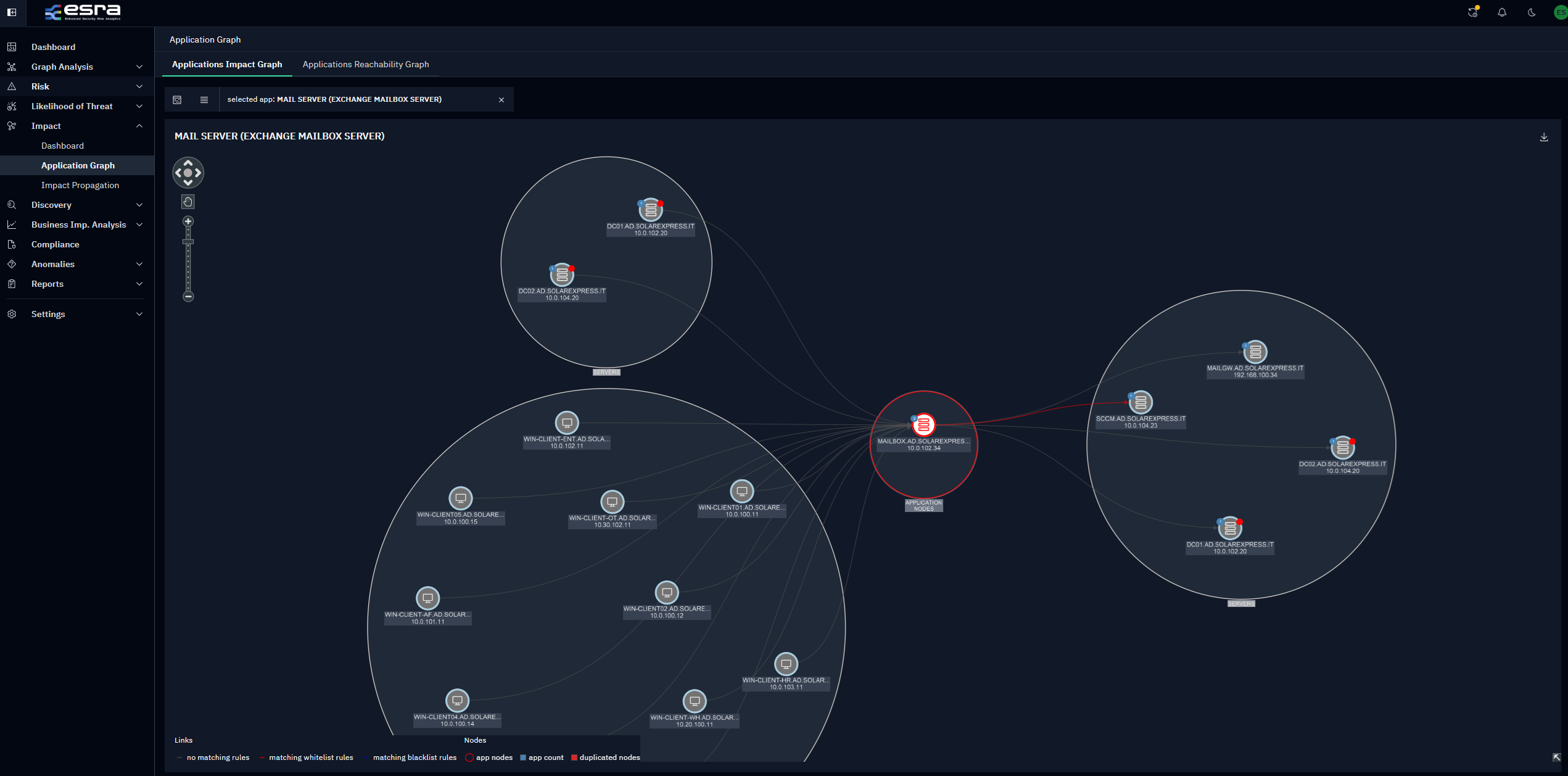
In this scenario, ESRA steps in by automating the discovery not only of physical assets but also of applications in use, with the goal of reducing the omissions typical of manual or outdated inventories. The platform reconstructs real communications within the observed perimeter and makes it possible to identify applications that were never recorded or that remain active without adequate oversight.
Finding a hidden application is only the first step, because the real value comes from analyzing its connections and how they affect overall risk. A data-driven Cyber Risk Management platform makes it possible to turn what was once opaque into usable information, linking technical discovery to impact assessment. For cyber and risk teams, this means working from a more solid foundation, one that depends less on people’s memory and stays closer to how the infrastructure actually behaves.
Opening the closet before the risk grows
Forgotten applications are dangerous precisely because they look harmless. They stay out of the main conversations and occupy marginal spaces, often surviving simply because no explicit decision was ever made to end them, all while continuing to exist inside the infrastructure with access rights and communications that nobody monitors anymore.
The mouse in the closet doesn’t wait to be noticed before it acts, and the same is true of whatever stays hidden inside a complex infrastructure. The difference between an organization that genuinely governs this risk and one that discovers it only when it’s too late comes down to the discipline with which available tools are used to look even where nobody looks anymore, more than to how many tools are in place. Opening the closet early almost always costs less, in time and resources, than discovering too late that something had been moving in there for months.
For anyone working in Cyber Risk Management, this means building a strategy that also accounts for what isn’t being watched today, because that is precisely where the exposures hardest to predict and most costly to manage tend to hide.
In recent years, Cyber Risk Management has undergone a profound transformation, driven by regulatory developments and steadily increasing technological complexity. Together, these forces have expanded organizations’ […]
A critical vulnerability on an endpoint and a board-level decision seem to belong to two different worlds, and yet the distance between them is what tests […]
When a risk analysis returns a reassuring rating across several areas of the perimeter, a company typically interprets the result as confirmation of its security posture. […]
Many security reports presented to the Board of Directors are still built around technical metrics that do not enable decision-makers to fully understand the organization’s real […]
Risk is not a Checklist. It’s a system of relationships. In cyber risk, a simplification continues to spread that, while convenient to adopt, struggles to hold […]
Artificial intelligence is rapidly entering business processes, influencing operational decisions, customer interactions, and business models. However, the discussion often tends to focus on technological aspects, while […]
The historical model: control, inventories, assessments For many years, Cyber Risk Management was interpreted as a simple control exercise, limited to specific and infrequent moments in […]
In recent years, Cyber Risk has been undergoing continuous transformation in terms of regulations, technologies, and methodological approaches. This transformation is often addressed by building increasingly […]
At the beginning of November, something happened that, until recently, seemed like a purely theoretical hypothesis. Anthropic released a report that made many industry professionals stop […]