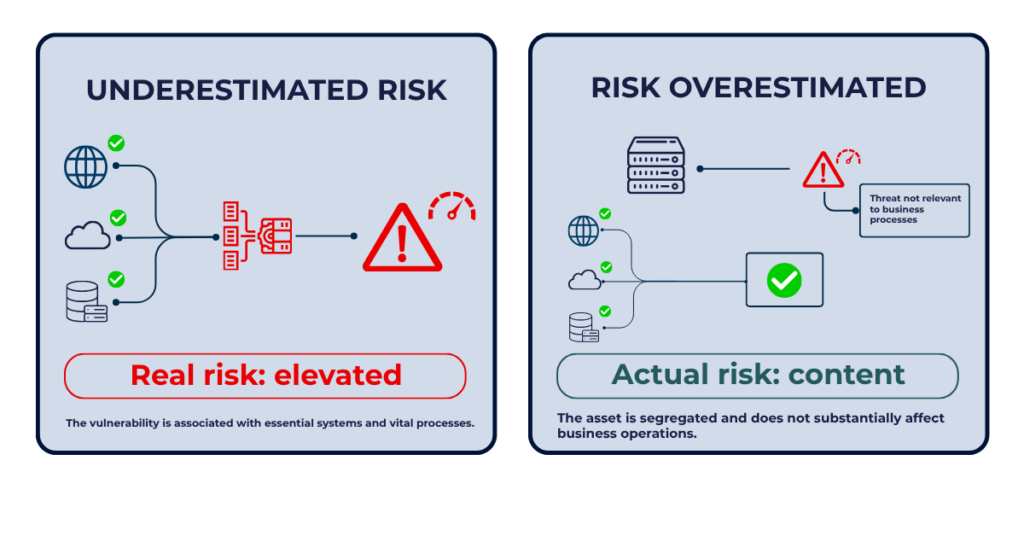
When a risk analysis returns a reassuring rating across several areas of the perimeter, a company typically interprets the result as confirmation of its security posture. Similarly, if a critical score emerges in a specific area, the most immediate reaction is to treat that finding as the absolute priority because a rating, by its very nature, produces a synthetic representation that captures attention too quickly.
A technical rating, however, describes a circumscribed condition, and stopping at that reading is not enough to understand the organization’s real risk. A reassuring result in a specific area can conceal broader exposure, just as an apparent criticality may shrink considerably when placed in its operating context.
Reading a technical data point without considering the context in which it exists yields an incomplete view of risk, because a vulnerability only gains real weight when observed within its infrastructure, where dependencies between systems and processes can amplify its impact well beyond the initial perimeter.
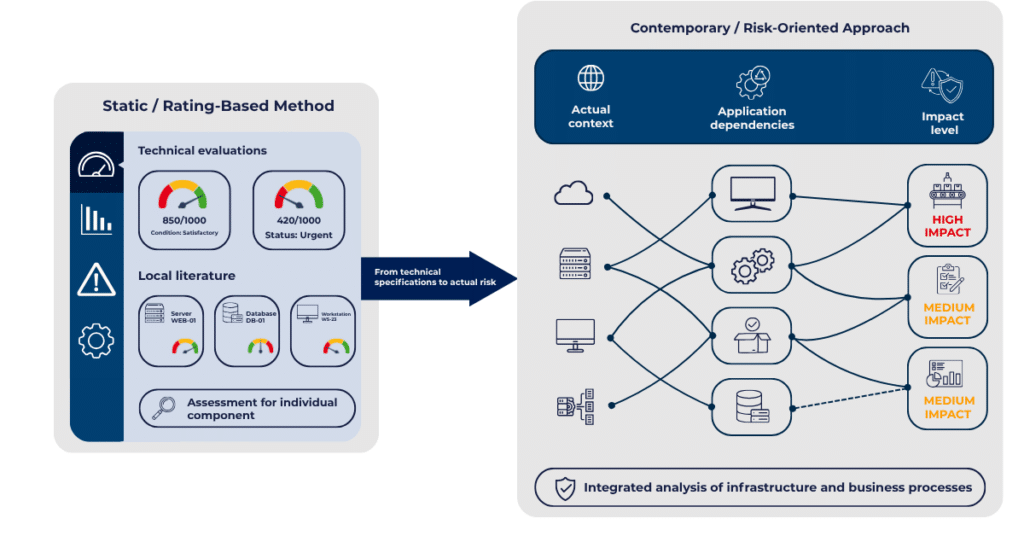
Static approaches to risk analysis have the advantage of producing an ordered, synthetic classification of technical findings, through scores that allow the state of various perimeter areas to be read at a glance. This evaluation method is useful because it enables quick identification of anomalies, measurement of exposure levels, and the construction of a first information base from which to launch control activities.
The limitation appears when the rating is treated as a complete representation of risk — when in reality that value does not necessarily reflect its relevance to the business. For each vulnerability, its true importance depends on where it is located, which systems it involves, and the concrete possibility that it could affect business processes.
For this reason, a static assessment can generate opposite and equally fragile interpretations. On one hand, it can create excessive confidence when individual indicators look positive, because it does not account for interactions between components. On the other, it can amplify the perception of urgency and generate alarm when a single score is critical, even in cases where that criticality has a more limited impact than other less visible exposures.
In a modern, data-driven risk analysis process, collecting technical scores is only the starting point — the real value of an assessment emerges when those scores are analyzed in relation to the infrastructure. To guide a deeper analysis, it is necessary to understand whether locally positive results could generate risk when observed as a whole, where the identified vulnerabilities are located, and which processes could be affected if those conditions were exploited.
This step is particularly relevant because enterprise infrastructures are not collections of isolated elements. Each system may support applications, enable communications, or contribute to the functioning of operational activities with varying weight for the organization. A useful assessment must be able to read risk as an effect of the relationships between perimeter elements, going beyond the simple observation of individual indicators.
To arrive at a mature risk assessment, it is necessary to analyze the infrastructure as a whole — only through this reading does it become possible to weigh technical indicators against actual exposure. Technical data gains value when connected to application dependencies, communications between systems, and the function each element plays in supporting business processes.
From this perspective, risk analysis cannot remain confined to the detection of vulnerabilities or critical configurations; it must reconstruct the relationship between what is observed at the technical level and what could happen at the operational level. A vulnerability takes on a different meaning when read in relation to the system it resides on, the connections that system maintains, and the process that could be impacted in the event of a compromise.
One of the most delicate aspects of cyber risk management is the ability to make risk legible outside the technical function. A list of ratings offers a useful measure for classifying findings, but often leaves open the most relevant question for decision-makers: understanding which exposure truly concerns the business and what impact could result from a failure to mitigate.
To build effective communication toward decision-making levels, technical indicators must be connected to system dependencies and effects on business processes, so that the risk assessment represents the organization’s actual exposure.
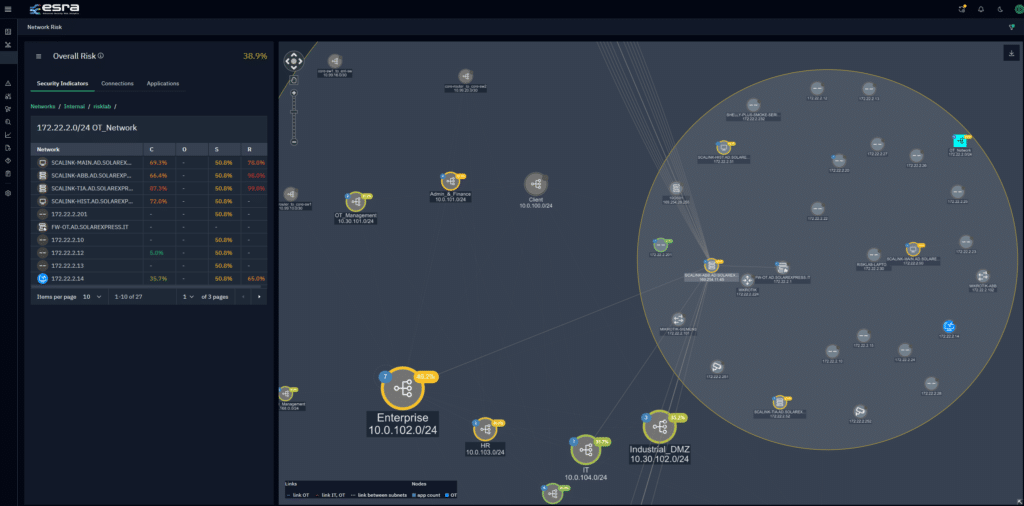
At ai.esra, we support this analysis through the construction of a digital twin of the infrastructure, based on actual communications between assets and the representation of relationships linking the different perimeter elements. This reading makes it possible to observe how threats and impacts propagate along real connections, clarifying the weight a vulnerability can carry on business processes and enabling decisions to be directed toward the areas where risk reduction produces the most significant effect for the organization.
ai.esra SpA – strada del Lionetto 6 Torino, Italy, 10146
Tel +39 011 234 4611
CAP. SOC. € 50.000,00 i.v. – REA TO1339590 CF e PI 13107650015
“This website is committed to ensuring digital accessibility in accordance with European regulations (EAA). To report accessibility issues, please write to: ai.esra@ai-esra.com”
ai.esra SpA – strada del Lionetto 6 Torino, Italy, 10146
Tel +39 011 234 4611
CAP. SOC. € 50.000,00 i.v. – REA TO1339590
CF e PI 13107650015
© 2024 Esra – All Rights Reserved